domingo, 29 de noviembre de 2009

Animation Mentor: weeks 8 and 9

Y por fin me pongo al día mostrándoos el último ejercicio, que es un ciclo de andar estándar, sin personalidad ni nada de eso, y visto de lado para simplificar el movimiento de las caderas y ponérnoslo un poco más fácil. La primera semana hicimos la planificación y las poses principales y en esta última semana lo pulimos un poco para que quedara un movimiento suave. Este es el resultado y aún no me lo han corregido, así que espero que a mi mentora le guste. :)

And finally I am updated by showing you my last exercise, a standard walk cycle, without any personality at all or anything like that, from the side view only to simplify the movement of the hips and make it easier for us. The first week we did the planning and the main poses and this last week we polished it a bit to get a smooth movement. This is the result and it hasn´t been checked yet, so I hope my mentor likes it. :)


Y también tuvimos que hacer una pose para Stu. Me encanta hacer poses para Stu. :) En la octava semana tuvimos que mostrarle haciendo algún esfuerzo físico:

And we also had to do a Stu pose. I love Stu poses. :) In the 8th week we had to show him using physical strength:


(El paraguas lo modeló Emilio en dos minutos, que si lo tengo que hacer yo, en dos horas igual consigo algo remotamente parecido a un paraguas...) XD

Y en la novena semana, preocupado. Finalmente, elegí la segunda de las dos que hice:

(The umbrella was modeled by Emilio in two minutes,
because if i had done that in two hours, I probably would have done something that would hardly look like an umbrella...) XD

And in the 9th week, concerned. Finally, I chose the second one of the two I made:


Animation Mentor: week 7

Un ejercicio un poco más complicado: combinar todo lo anterior para crear vida en una pelotita con cola. Esta pelotita ha de cumplir todos los principios básicos vistos hasta ahora, ha de haber overlap en la cola, ha de haber squash y stretch y, en fin, todo un conjunto de cosas que hacen de este el ejercicio más difícil hasta el momento.

A slightly more complicated exercise: to combine all the previous stuff to create life in a small ball with a tail. This ball needs to follow all the basics principles we have seen so far, there should be overlap in the tail, squash and stretch and, well, a bunch of things that make this exercise the most difficult so far.


Animation Mentor: week 6

Durante la sexta semana nos centramos en estudiar cómo se comportan los objetos cuando hay otro objeto que los guía (se le llama overlapping). Este fue mi ejercicio:

During the 6th week we focused on learning how an object behaves when other objects leads the movement (it is called overlapping). This was my exercise:


Y aquí mi planificación:

And here my planning:

Animation Mentor: week 5

Durante la quinta semana de Animation Mentor tuvimos que hacer una nueva pose de Stu que mostrara devastación, es decir, una gran tristeza. Por otra parte, tuvimos que hacer un circuito con una pelota, practicando por primera vez en el curso el principio de squash and stretch, que consiste en encoger la pelota cuando golpea contra algo para dar mayor impresión de impacto, y en estirarla cuando coge velocidad para dar mayor sensación de velocidad. Son recursos muy usados en animación, aunque recomiendan no abusar demasiado y usarlos con precaución, sobre todo en animación realista.

Aquí está la animación:

During the 5th week in Animation Mentor we had to make a new Stu pose that expressed devastation, I mean, great sadness. On the other hand, we needed to do an obstacle course with a ball, practising for the first time squash and stretch, that consists of squashing the ball when it hits something to create a bigger impression on the impact, and of stretching it when it goes fast to increase the sensation of speed. It is a very common tool in animation, but it is recommended to use it in moderation, especially in realistic animation.

Here is the animation:


A mi mentora no le gustó demasiado, porque se suponía que la pelota tenía que comportarse como un balón de fútbol y la mía se comporta más bien como una pelota pequeña. Como corregir este problema conllevaba cambiar todo el circuito, no hice revisión del ejercicio.

Aquí mis bocetos para Stu:

My mentor didn´t like it too much, because it was supposed to behave as a soccer ball, and mine was behaving more as a small light ball. As making a review would have meant to change the whole circuit, I didn´t do any review.

Here are my Stu sketches:


Y aquí las tres poses que más me gustaron. Finalmente elegí la primera de ellas. Esta sí le gustó a mi mentora.

And here the three poses I liked best. Finally I chose the first one. My mentor liked this one.

Bye bye, Ninja Theory!

Ha sido un verdadero placer trabajar para esta empresa durante los últimos tres meses. He aprendido un montón de cosas, entre ellas que aún tengo mucho que aprender, y he conocido a gente estupenda y con un nivel profesional impresionante. Ahora este período se ha terminado y ya estoy de vuelta en España, sigo con Animation Mentor y en breve prepararé una reel para buscar un nuevo trabajo en este competitivo mundillo. A ver qué pasa. :)

It has been a real pleasure to work for this company during the last three months. I have learnt lots of things, among them that I still have a lot to learn, and I have met great people with an impressive professional level. Now this period is finished and I am already back in Spain, I am still with Animation Mentor and soon I will prepare my new reel to look for another job in this competitive world. Let's see what happens. :)

martes, 24 de noviembre de 2009

Animation Mentor: week 4

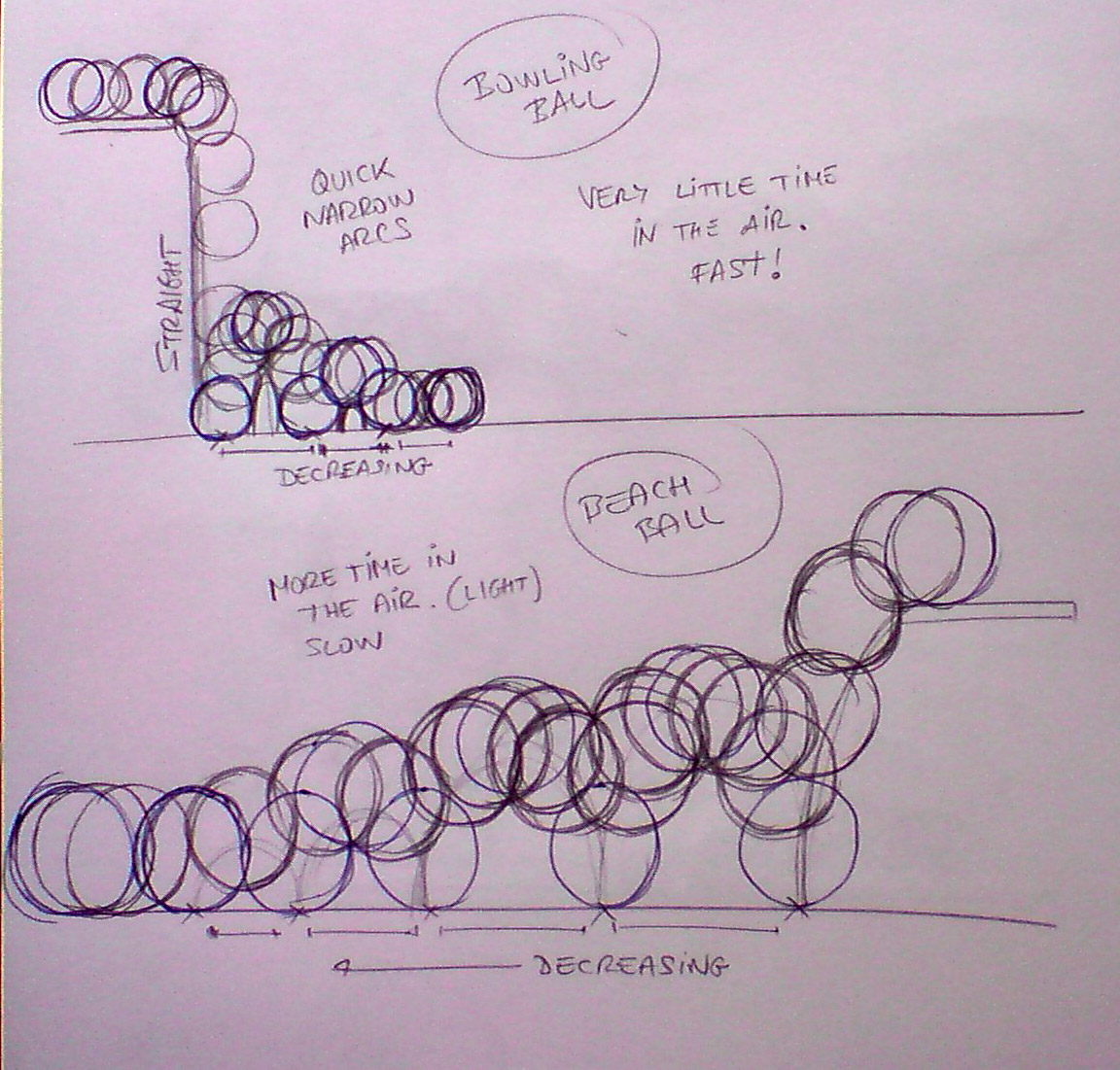
La cuarta semana de Animation Mentor nos tocó profundizar en el tema del timing y el spacing que ya habíamos visto con la primera pelota botando. En esta nueva actividad, comparamos cómo se mueve una bola ligera y una bola pesada, en mi caso una bola de playa de estas que no pesan nada y una bola de bolos. Es muy interesante intentar averiguar cómo funciona el timing para cada una de ellas: los botes de la pelota pesada son muy rápidos mientras que los de la ligera son leeentos (esto significa que tienen timing diferente), y la distancia entre los "dibujos" (o frames) de la ligera es casi siempre la misma con pequeñas variaciones, mientras que para la pesada la diferencia es considerable.

Aquí os pongo mi planificación:

The fourth week in Animation Mentor we had to go deeper into timing and spacing, which we had already studied when we did the bouncing ball. In this new assignment, we compared how a light ball and a heavy one move, in my case a beach ball and a bowling ball. It is very interesting try to figure out how timing works for both of them: the bounces of the heavy ball are very fast while the bounces of the light ball are slooow (which means they have different timing), and the distance between "drawings" (or frames) in the light one is very even, while for the heavy one is quite big.

Here is my planning:


Y aquí mi animación:

And here is my animation:


Y aquí la revisión que hice cuando mi mentora, Ruth Daly, me dijo que la pelota ligera se veía aún muy pesada al final de cada bote. Aquel día no lo veía claro, pero ahora, cuatro semanas después, me parece evidentísimo.

And here is the revision I did when my mentor, Ruth Daly, told me that my light ball was looking too heavy at the end of each bounce. That day I couldn´t see it properly, but now, four weeks later, it is so evident!


La revisión tampoco me convence, ahora veo la pelota demasiaaado ligera. Supongo que un término medio estaría mejor, pero bueno, seguiremos trabajando. Al menos sí que ahora parece más ligera, ¿o no? :)

Por cierto, no os cortéis de comentar y criticar lo que queráis. Es posible que no sepáis de animación (o sí), pero de pelotas que botan sabéis lo mismo que yo, y eso es lo que cuenta. El sólo hecho de decir: "yo esa pelota no me la creo" es probablemente una de las mejores críticas que se pueden recibir. Así que ánimo con vuestras aportaciones y a ver si aprendo algo nuevo gracias a vosotros también. ;)

The revision doesn´t look very convincing to me either, now I see the light ball tooooo light. I guess something inbetween the original and the revision would be better, so we will keep on working. At least, now it looks lighter, doesn´t it?

By the way, do not hesitate to comment and critique as much as you like. It is possible that you don´t know anything about animation (or maybe yes), but about bouncing balls you know the same as me, and that is the main thing. The comment: "That movement is not believable" is probably one of the best critiques I as an animator can receive. So feel free to comment and let's see if I learn something new with you. ;)

sábado, 21 de noviembre de 2009

La importancia de planificar - The importance of planning

¿Por qué es importante planificar la animación antes de comenzarla? Porque evita muchos problemas posteriores. ¿Alguna vez habéis empezado a cocinar algo sin comprobar si teníais todos los ingredientes y al cabo de un rato os habéis dado cuenta de que necesitáis uno esencial que no tenéis? Entonces tenéis dos opciones: salir corriendo a comprarlo o preparar otra comida. Pues con la animación es parecido. Si no sabes de antemano de qué ingredientes va a constar y cómo hay que mezclar esos ingredientes, en su justa medida y en su preciso momento... tendrás problemas. Con la práctica, muchos animadores son capaces de empezar a animar directamente, sobre todo cuando tienen fecha de entrega y les pueden las prisas. Pero es una mala práctica. En animaciones mínimamente complicadas, planificar te puede ahorrar muchísimo tiempo. Yo tengo sólo unos pocos meses de práctica en el mundo de la animación, pero ya he podido comprobarlo sobradamente. Así que:

¡PLANIFICAD VUESTRAS ANIMACIONES!

Why is planning the animation so important? Because it avoids lots of problems. Have you ever started cooking something without being sure that you had all the ingredients and after a while you discover that you need an essencial one you don´t have? Then you have two options: run and buy it or make another meal. Well, with animation something similar happens. If you don´t know in advanced what ingredients you need, how to mix them, when and how much... you are in trouble. With practise, many animators can start animating directly, especially when they have to meet a deadline and they are in a hurry. But it is a bad practise. In animations that are a bit more complicated, planning can save you lots of time. I have only some months of experience in this industry, but I have already realised that too well. So:

PLAN YOUR ANIMATIONS!